General Mechanical

General Mechanical

Topics related to Mechanical Enterprise, Motion, Additive Print and more.

Fluid/Structure interaction – Modeling the fluid flow within a deformed tubing

    • zjuv9021
      Subscriber

      Hi all,


      I am trying to create a fluid/structure interaction with my bent catheter, in the hopes of optimizing the degree at which the catheter occludes.


      My thoughts were to create the inside of the catheter lumen, and have it display the fluid flow as the catheter is bent and displaced as has been seen in my previous posts:


      Please see attached... is there a relatively simple way to do this? The inner lumen tubing is simply a constant psi of 1, the reason for doing this would be to use the CFX as an output parameter to ultimately try to maximize the deformed inner luminal area over the deformation, so as to not reduce delivery of this fluid.


      Kind Regards,


      Zach 

    • Goenitz
      Subscriber

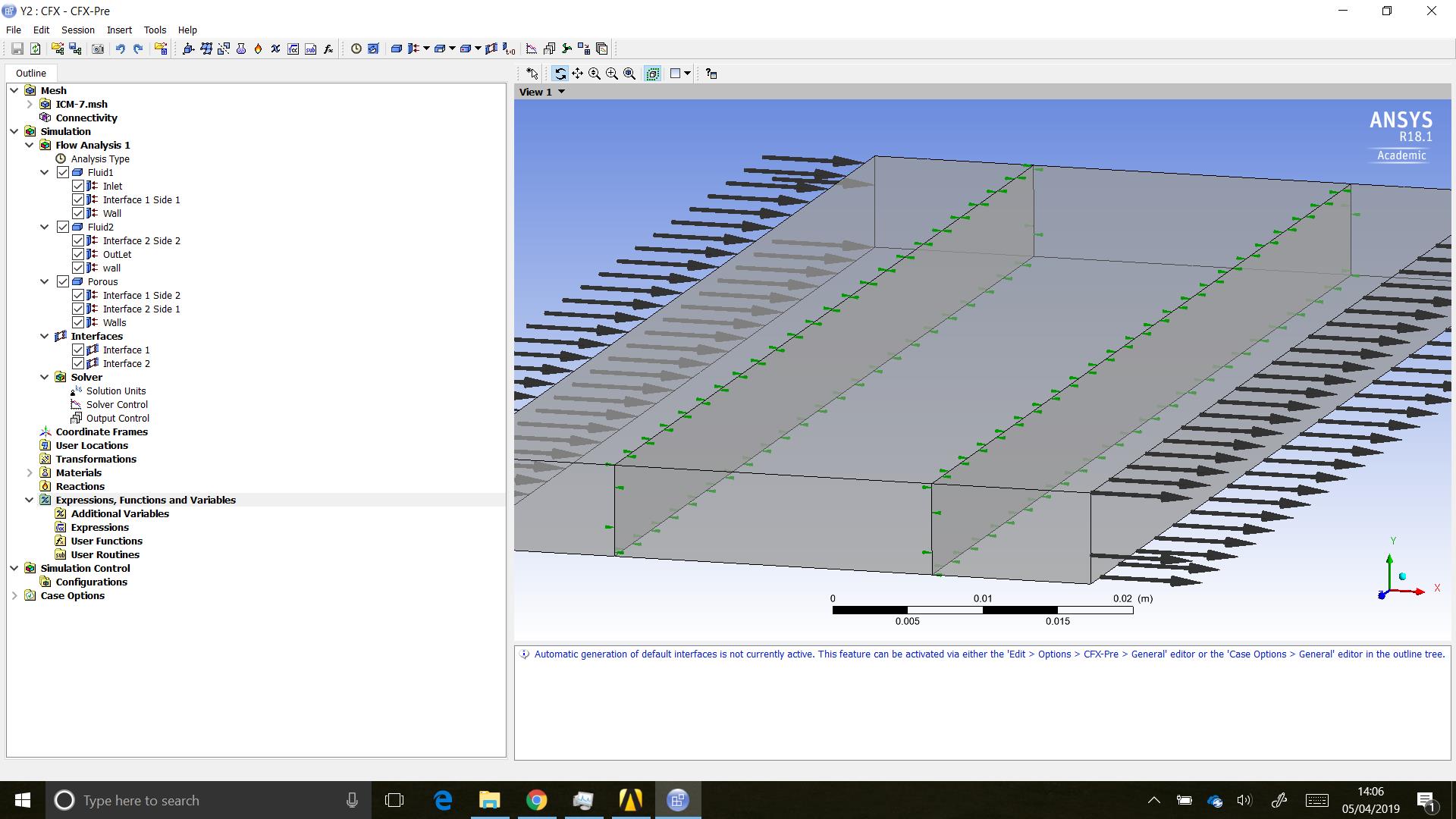
      I have a porous fluid interaction but mass isn't conserved across the interface. The velocity gets 10 times higher after convergence.  I have used both structured and unstructured mesh and GCI mesh connection so seems no issue of conformal/non-conformal mesh. The flow is simple Laminar. Volume porosity is 0.1


    • zjuv9021
      Subscriber

      I'm a little confused as to what I am seeing displayed. Is this a different example? It does not look like my attached reference.


      Thank you,


      Zach

    • Ryan O'Connor
      Ansys Employee

      Goenitz: It appears that your post is unrelated to the original question in this thread. Please post this question as a new entry.


      Zach: It sounds like you want to do a parametric study whereby for each design point CFX takes on the deformed shape of the catheter. To do this you would set up the case as a 1-way FSI using system coupling. This will allow for Mechanical to pass displacements to CFX.

    • zjuv9021
      Subscriber

      Thank you Ryan,


      Can the area restriction as this catheter tubing is occluded (% occlusion) then become an output parameter, with some input parameters being structural (e.g. material characteristics, geometry) to optimize and reduce the likelihood of the fluid region becoming fully restricted?


      To be clear, I would like to see how the structural portion deforms the fluid region, so ultimately would like to see a deformed inner lumen over time as the catheter is bent and displaced.


      Also, Could you demonstrate via workbench what this configuration would be like with the system coupling as well?


      I'm more experienced in CFX, can this also perform the fluid solution via 1 way fsi?


      Zach

    • zjuv9021
      Subscriber

      All,


      To further add, I have done some personal investigation and think I am on the right path... I have created a solid fluid portion inside of the catheter, with the "Inlet" defined on the left side (within the anchor), and the outlet is within the rigid tubing on the far right hand side that will rotate down via rigid joint at -30 degrees:
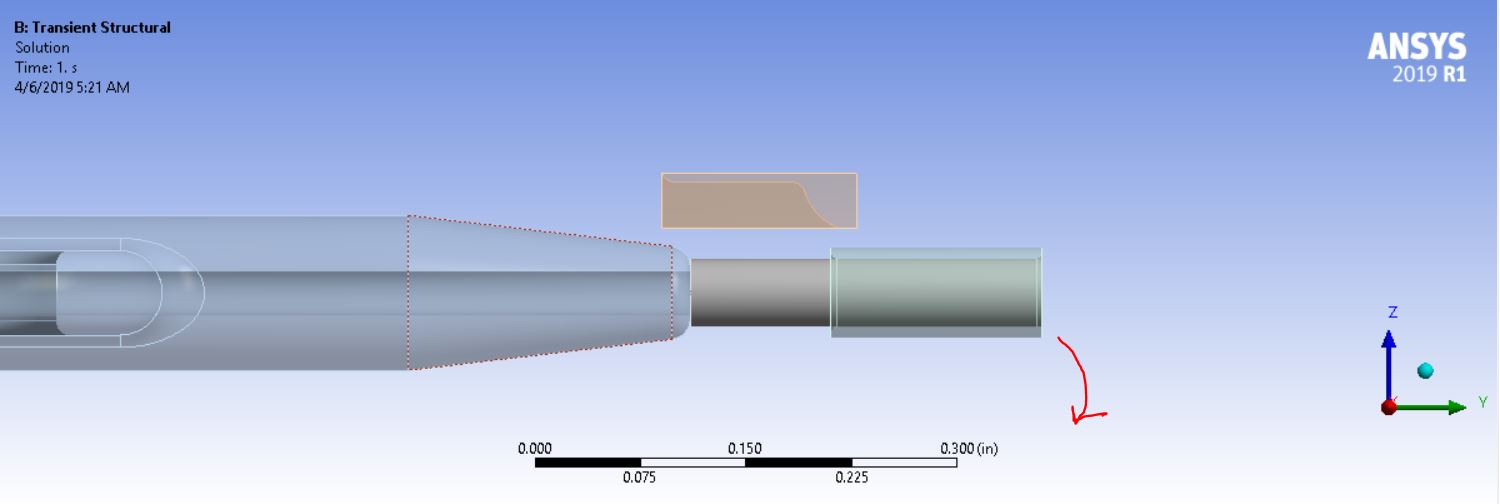


      of note: The rigid tubing is not rotating AT the very far right, but rather at the far left of the most outer sheath as is displayed above.


      Within CFX, I have defined my Inlet as stationary, as it should not be deformed nor change outside of the rigid tubing, and my wall is system coupled with a FSI interface within the tubing defined in Mechanical.


      My question: What do I do with the Mesh Motion Outlet condition since that face will effectively be rotating as a rigid joint at -30 degrees? The rigid joint is currently rotating the -30 degrees over t=1 s in transient structural. 


      Is some form of cos, sin expression necessary for this? Are there any examples that I could follow?


      Kind regards,


      Zach

Viewing 5 reply threads
  • The topic ‘Fluid/Structure interaction – Modeling the fluid flow within a deformed tubing’ is closed to new replies.