Ansys Assistant will be unavailable on the Learning Forum starting January 30. An upgraded version is coming soon. We apologize for any inconvenience and appreciate your patience. Stay tuned for updates.
General Mechanical

General Mechanical

Topics related to Mechanical Enterprise, Motion, Additive Print and more.

SMART Method for Crack-Growth Simulation

    • HanakJiri
      Subscriber

      Hello,


      I am using SMART method in Ansys APDL for crack growth simulation. I want to ask, what SMART uses for determine the next crack growth direction. In the help section about this method, there is only stated wich condition must be fulfilled for crack to start growing and what will be the next crack extension. But there is not mention according wich theory SMART determine the crack extension direction.


      Is it using Sih criterion (needs K1 and K2) or something else?


      Thanks for reponse.

    • David Weed
      Ansys Employee

      Hi,


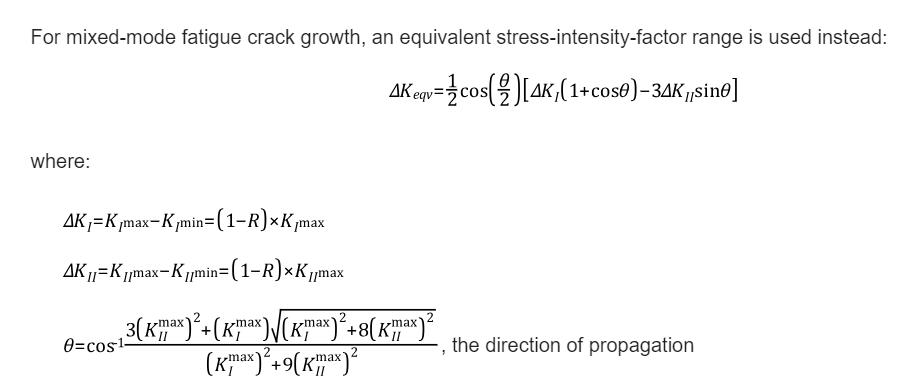
      In the context of fatigue crack growth, the direction of the crack is determined by the interaction of KI and KII as explained here:


      https://ansyshelp.ansys.com/account/secured?returnurl=/Views/Secured/corp/v193/ans_frac/franundcgrowmech.html%23fraccgrowmechanics


    • HanakJiri
      Subscriber

       Hello,


      thank you for response. I am using static crack growth, so I didnt pay much attention to the context of the fatigue crack growth. Is ansys using the same equation in case of static growth please?


      Thanks

    • David Weed
      Ansys Employee

      Hi,


      Yes, this is valid for static crack growth as well. Instead of using delta K, we simply use static KI and KII values.

    • HanakJiri
      Subscriber

      Great, thanks a lot! Last question, you are using the max value of KI and KII or the avarage value across the crack front?

    • hoda2020
      Subscriber
      I used smart crack method in ansys workbench 19.2 on notched steel beam to study fatigue crack growthnI research more in this method, but I can't insert load as step applied instead of ramped appliedn
    • hoda2020
      Subscriber
      Please, any one can help men
    • danielshaw
      Ansys Employee
      SMART automatically applies the load in one substep. The specified number of substeps controls the number of solutions performed with each new crack increment.n
    • hoda2020
      Subscriber
      Thanks for your response,nI used in smart methodn1/ Methodology is. (fatigue) n2/ used (life cycle) n3/ stress ratio 0.4nWhen I insert force , as default (ramped) must be change to ( step applied) automatically( as you mean in your comment)But this don't occur, the value still as ramped not step nHow solve this problem? nIs the problem in my version of program or there's another solution?
    • danielshaw
      Ansys Employee
      You can issue the KBC,1 command to force the load to be step applied.n
Viewing 9 reply threads
  • The topic ‘SMART Method for Crack-Growth Simulation’ is closed to new replies.
[bingo_chatbox]