Ansys Assistant will be unavailable on the Learning Forum starting January 30. An upgraded version is coming soon. We apologize for any inconvenience and appreciate your patience. Stay tuned for updates.
General Mechanical

General Mechanical

Topics related to Mechanical Enterprise, Motion, Additive Print and more.

Hyperelastic Experimental data – material definition

    • naveenM
      Subscriber

      Hello,


      Can anyone please help me with the following definitions for hyperelastic material.


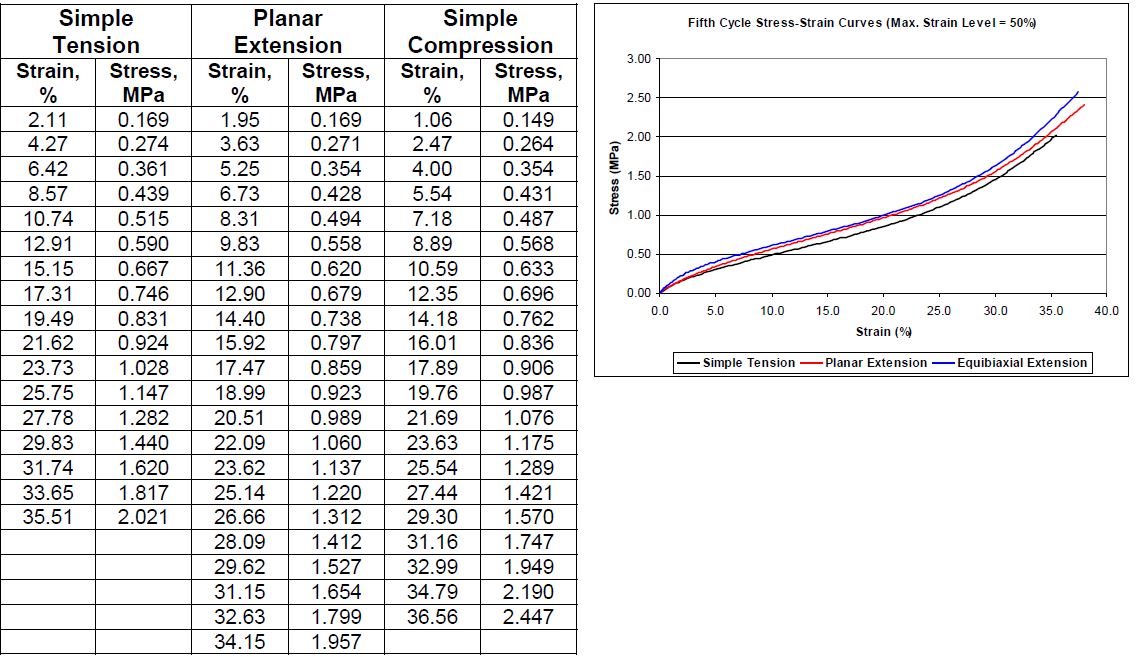
      I ve got Simple Tension, Simple compression and Planar extension test data from experiments.


      If i am not wrong I have entered Planar extension results into Shear test (inside ansys).


      What should I select for the simple tension and simple compression?


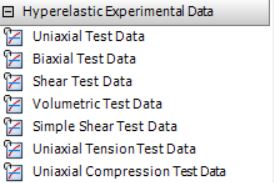
      Confused between UNIAXIAL TEST AND UNIAXIAL TENSION TEST.


      Thanks in advance.

    • jj77
      Subscriber

      Simple tension and simp. comp. I would put in the uniaxial tension/comp. test data respectively.


      Planar extension not sure what you mean, are you pulling it in two directions in a plane, then it is biaxial test data perhaps.


      Try this out and replicate your test/exp, in ansys and match the two.

    • naveenM
      Subscriber

      Thanks jj77,


      This might explain a bit better. this is the data sheet provided by the manufacturer. They have considered the simple compression as Equibiaxial extension.


      BUT WHATS THE DIFFERENCE BETWEEN     UNIAXIAL TEST DATA     AND    UNIAXIAL TENSION TEST DATA?


      Thanks

    • jj77
      Subscriber

      See help manual (look for TB, and EXPE, and  UNIAXIAL or UNITENSION), below is a short description of them:


      TBOPT:


      Experimental data type:


      UNITENSION --


      Uniaxial tension experimental data.


      UNICOMPRESSION --


      Uniaxial compression experimental data.


      UNIAXIAL --


      Uniaxial experimental data (combined uniaxial tension and compression).


      BIAXIAL --


      Equibiaxial experimental data.


      SHEAR --


      Pure shear experimental data (also known as planar tension).


      SSHEAR --


      Simple shear experimental data.


      VOLUME --


      Volumetric experimental data.


    • Bhargava Sista
      Ansys Employee

      Naveen,


      The uniaxial test data (includes tension and compression) is used for curve-fitting hyperelastic models to the data for calculating material properties. Whereas the uniaxial tension data is used when you're using the response function hyperelastic model, which does not require any curve-fitting. The reason we have two separate ones is that in curve-fitting, there is no difference in handling the uniaxial tension and compression data but they are handled differently in response function formulation.

Viewing 4 reply threads
  • The topic ‘Hyperelastic Experimental data – material definition’ is closed to new replies.

[bingo_chatbox]