Ansys Assistant will be unavailable on the Learning Forum starting January 30. An upgraded version is coming soon. We apologize for any inconvenience and appreciate your patience. Stay tuned for updates.
General Mechanical

General Mechanical

Topics related to Mechanical Enterprise, Motion, Additive Print and more.

Applying uniform tension in modal analysis of 2D pre-stressed annular membrane

    • kravky
      Subscriber

      Hello


      i am trying to model simplified model of tympanic membrane. I would like to model 2D sectorial annulus membrane according to followin fig. 


      My goal is to find natural freq. of this membrane. The parameters i would like to use: 
      R1=0,5mm  (inner radius)
      R2=4,5mm (outer radius)
      alfa=20deg
      E=33MPa
      Poissonous ratio = 0,3
      density=1200kg/m^3
      thicknes=0,1mm
      T=35N/mm^2 = 35000000Pa (uniform tension in membrane)


      Firstly i used ASYS Design modeler for creating geometry. I created surface with thicknes 0,1mm 
      Next i defined material properties and boundary conditions in ansys mechanical (fixed inner and outer radius), however i cannot define tension. I need to set T=35MPa in order to achieve pre-stress in structural analysis and then i could go onto modal analysis. 
      The problem is i cannot apply pressure to edge. 
      How could i apply uniform tension T=35MPa to entire membrane  ? (membrane is considered as prestressed) 
      Am I doing something worng when applying boundary condition?

      Thanks

    • peteroznewman
      Subscriber

      Hello kravky,


      I have not used this command myself, but use ANSYS Help to search for INISTATE.


      This command seems to allow the assignment of an initial state of stress on elements at the beginning of an analysis.


      There are some examples in the ANSYS Help system.


      Regards,
      Peter

    • peteroznewman
      Subscriber

      [EDITED] Hello again kravky,


      If you don't need to use the Temperature variable in the simulation, you can use a temperature load with a CTE material property to create the tension in the membrane.


      • Create a material with a CTE of 0.01 /degree C.

      • Set the Environment Temperature to 50 C. 

      • Add a Thermal Condition to the model of -24.3 C


      This creates a uniform stress of 35 MPa with the geometry and material properties listed above.
      Note: Workbench does a terrible job of drawing contours that have a constant value!
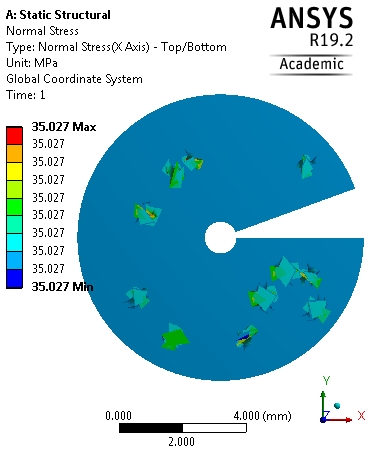


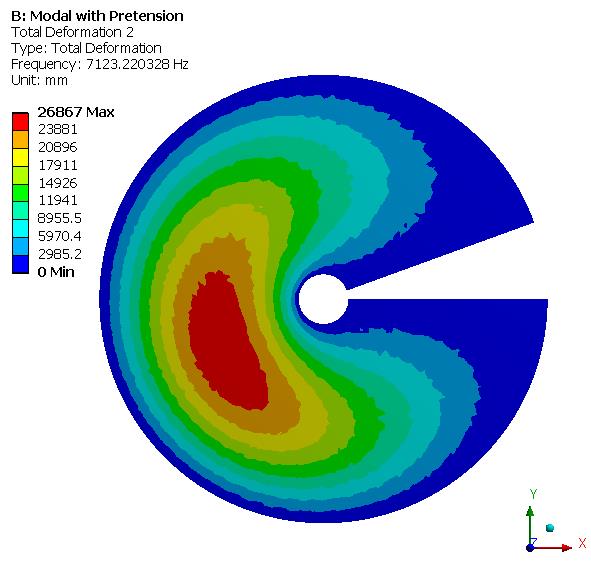
      [EDIT] Turn on Large Deflection in Static Structural for a more accurate Modal result.
      There is a warning message if you forget to turn on Large Deflection. Ignore that at your own risk!


      You can perform a Pre-Stress Modal analysis on this solution.
      The first mode below has a natural frequency of 7.1 kHz.
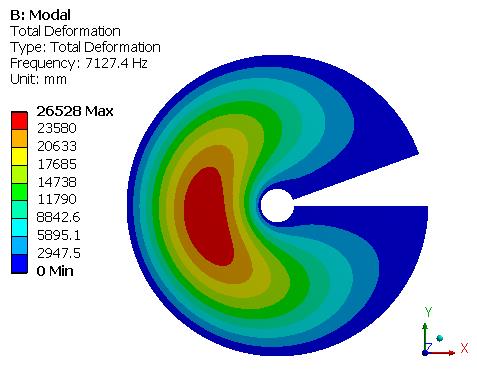


      ANSYS 19.2 [EDITED] archive is attached. I put shell elements on a surface, which is better than having solid elements on a thin solid.


      If this method works for you, please mark this post as Is Solution or ask a follow-up question.


      Regards,
      Peter

    • kravky
      Subscriber

      Thanks a lot!


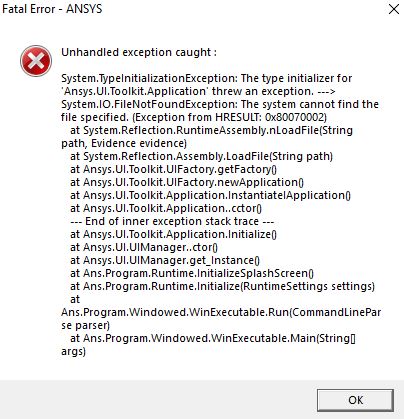
      Well i could not open your file because i dont have 19.2. i tried to install ANSYS 19.2 academic, but if i try to open your project or even workbench 19.2 i am getting error:


      but its not the problem. i just wanted to mention that if you chose my parameters in your simulation you should get the 1st modes frequency around 400Hz or 600Hz. And also the displacement is 26000mm ? It seems strange.

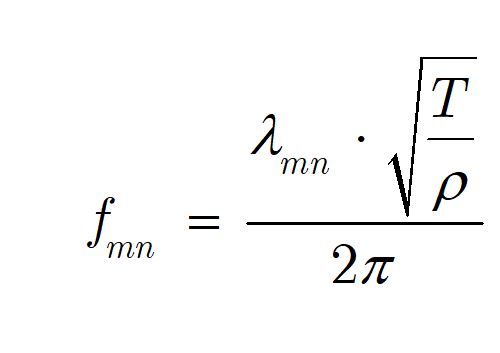
      I made an anallytical calculation for this case. You can analytically determiny freq. according to: 


      where  LAMBDAmn is the mth positive root and can be determined from


      where Jn, Yn are the Bessel functions of first kind and second kind.  for 0 order (n=0) and for first freq. (m=1) i calculated LAMDA10=0,7484


    • peteroznewman
      Subscriber

      What release of ANSYS are you using? You open the file attached by staring Workbench 19.2 and using File, Restore Archive.

    • peteroznewman
      Subscriber

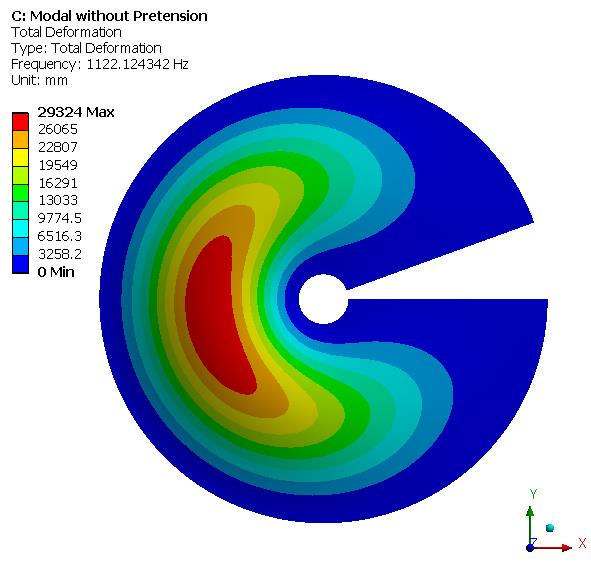
      Your description didn't specify if the edge constraint was clamped or simply supported (rotation free). The archive above was for a clamped edge.


      I changed the edge constraint to Simply Supported and solved the Modal frequency with no pretension and again with the 35 MPa pretension. The modal frequency with no pretention is 596 Hz.


      Pay no attention to the magnitude of the displacement. It is completely meaningless. Only the Frequency and the shape of the deformation is important.


      Regards,
      Peter

    • kravky
      Subscriber

      I am using ANSYS 19.1. I tried to install 19.2, however i can not open workbench 19.2. 19.1 runs without problems.

    • kravky
      Subscriber

      The edge constraint should be clamped.  596Hz is for clamped edges or for simple support? 


      Thank You

    • peteroznewman
      Subscriber

      596 Hz is for Simply Supported with zero pretension.
      1120 Hz is for Clamped edges with zero pretension.


      Were you able to make a version of this in 19.1?

    • kravky
      Subscriber

      I havent been able to make it compatible with 19.1 yet. I will try find a solution. 


    • peteroznewman
      Subscriber

      You have to build it from scratch, there is no going backward. I made a 19.1 model for  you. As I was redoing the model, I paid attention to the warning message about Large Deflection in the Pretensioned Modal result and I turned Large Deflection On and the result was very different to what I got above in 19.2 when I ignored the warning message. I have since edited the post above to put in the correct values.


      The 19.1 archive is attached.

Viewing 10 reply threads
  • The topic ‘Applying uniform tension in modal analysis of 2D pre-stressed annular membrane’ is closed to new replies.
[bingo_chatbox]