Ansys Assistant will be unavailable on the Learning Forum starting January 30. An upgraded version is coming soon. We apologize for any inconvenience and appreciate your patience. Stay tuned for updates.
General Mechanical

General Mechanical

Topics related to Mechanical Enterprise, Motion, Additive Print and more.

Plasticity Model of porous media using GTN

    • OA
      Subscriber

      Dear all,

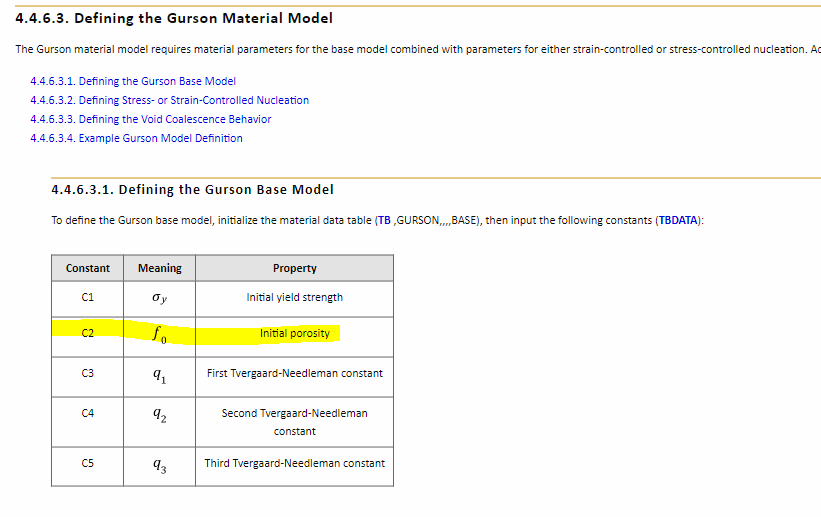
      When one models a porous structure in "ANSYS APDL" using Gurson model, some GTN parameters including the volumetric porosity fraction (i.e. initial porosity) are entered using the TBDATA command.

      In these models, are we still supposed to draw the voids physically through the solid matrix after entering the initial porosity? or Does ANSYS automatically consider "virtual microvoids" through a solid matrix after entering the initial porosity?

      If we must incorporate the voids into the matrix physically, how can we impose spherical voids in a "2D axisymmetric" model?

      Many Thanks

    • Ashish Khemka
      Forum Moderator

      Hi,

      From our documentation:Gurson's model is a plasticity model (TB GURSON) used to simulate ductile metal damage. The model is a micromechanics-based ductile damage model incorporating the void volume fraction into plasticity constitutive equation to represent the ductile damage process of void grow void nucleation and void coalescence. For more information see Gurson's Model in the Theory Reference for the Mechanical APDL and Mechanical Applications and TB GURSON command documentation.

      Regards,

      Ashish Khemka

      • OA
        Subscriber


        Hi,

        Thank you but thats not the answer.

        We already know all about Gurson theory and we read the TB command documentation. The answer of our question is not there either. Thats why we wrote the question in this forum.

        OA


    • John Doyle
      Ansys Employee

      With respect to the Gurson model, you do not define physical voids. You define the "initial porosity" f, which is the void fraction.  And then you specify either stress or strain controlled nucleation, depending on the data you have and what effect you are trying to simulate.

      Please refer to Section 4.4.6.3 of the R2023-R1 MAPDL Material Reference Guide for more details on inputs required.

      • OA
        Subscriber

        Thank you John. Is it also possible in ANSYS APDL to consider a model with actual (physical) voids by using Gurson theory?


    • John Doyle
      Ansys Employee

      I am not aware of anyone modeling voids discretely at the micrscopic level and using this in an FEA model.  I suppose you could build a simple cube with and without voids to calculate the void ratio for use in a macroscopic gurson model, but you could just as easily do that calculation (void ratio) by hand.

    • John Doyle
      Ansys Employee

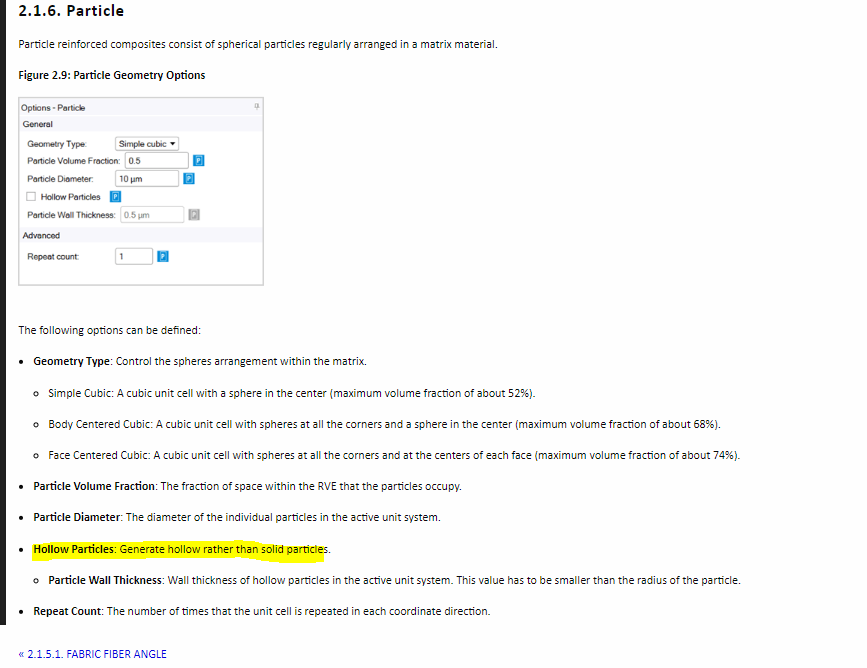
      Perhaps there are some model generating tools in Material Designer that would be helpful.

      • OA
        Subscriber


        Please let me ask the question in other words..

        Consider that i model a porous structure in a CAD software for a certain porosity f0=0.1 and transfer it to the ANSYS APDL. Afterall, is it possible to apply the Gurson theory on such a model by defining the initial porosity same as the physical value 0.1?

        Many thanks


Viewing 4 reply threads
  • The topic ‘Plasticity Model of porous media using GTN’ is closed to new replies.
[bingo_chatbox]